Showing posts with label Kawasaki Bikes. Show all posts

Sunday, April 3, 2011

Kawasaki Versys

Kawasaki has introduced a brand new multi purpose motorcycle designed for all sorts of different riding styles and needs, the 2008 Versys. It's a 649cc 8 valve parallel twin that looks pretty good.
Kawasaki press release follows:
The new 2008 Kawasaki Versys is a machine which occupies a hard to define sweet spot in the motorcycling universe. Is it a practical commuter? Long-legged urban assault vehicle? Sportbike? Light Tourer?
The answer on all counts is a resounding Yes! This isn’t a niche specialist but rather a jack-of-all-trades with user-friendly versatility as one of its many charms.
The 649cc parallel twin and the neutral handling and light steering chassis of the Ninja 650R sportbike made the perfect starting point for this comfortable gridlock commando. A swoopy gull-wing swingarm, long-travel inverted 41mm fork, six-spoke superbike-inspired wheels, adjustable-height windscreen and a comfortable cockpit were combined to create a motorcycle that just begs to be ridden wherever the pavement might lead.
The compact liquid-cooled, fuel-injected, DOHC, 8-valve, 649cc parallel twin engine was modified for the Versys motorcycle so it delivers smooth power that’s well-suited for off-the-line acceleration and flexible torque in the cut-n-thrust of a rider’s morning commute. This engine’s overall characteristics are entertaining for even the most advanced riders, yet predictable enough to inspire confidence in less-experienced motorcyclists.
Full press release and more photos below:
Its suspension offers the next level in sophistication: an advanced Showa rear shock featuring a free piston and two-stage damping valves for progressive compression damping which firms significantly as the shock moves through its stroke. This allows a longer wheel travel with a feel that is initially soft like a dual sport, but firms to near sportbike levels as suspension loads escalate. Of course, this advanced shock is fully-adjustable and connected to a beautiful aluminum gull-wing swingarm that is longer than average, thanks to a short/compact engine and chassis.
Up front, the Versys suspension continues the high-tech approach with a fully-adjustable 41mm tapered-tube inverted fork that combines the best of off-road and sportbike suspension action for a stiffness balance that is a perfect compliment to the chassis settings. In addition to a more-comfortable ride, the long-travel suspension’s soft-stroke allows easy control of the chassis’ running angle by shifting the rider’s weight.
Complimenting the able suspension is the carefully designed cockpit that features a two-piece seat constructed to provide optimum comfort to both the rider and passenger. An easy-to-read and informative instrument panel allows riders to quickly scan the gauges and get their eyes back on the road. Capping off the comfort list is an adjustable windscreen that can be raised or lowered to three positions in 20mm increments.
Engine
649cc parallel twin-cylinder, DOHC engine is the most compact in its category.
The engine is considerably smaller than that of the Ninja 500 and helps reduce the dimension of the entire motorcycle
Tuned to deliver smooth, responsive power in the low-to mid-rpm range with exceptional roll-on response ideal for negotiating city traffic
Triangular crank and transmission shaft layout makes it short front to back, a semi-dry sump oil system reduces overall engine height, and the narrow pitch of the chrome composite plated aluminum cylinders helps reduce engine width
Muffler with 3-way catalyzer and bullet-tip opening is mounted below the engine to help lower the center of gravity and aid weight centralization
180-degree crankshaft plus balancer shaft for extremely smooth engine operation
Oil jets on the connecting rod big ends spray oil on the undersides of the pistons to aid cooling
Liquid Cooling
Fewer external hoses because the coolant is routed through the engine cases
Digital Fuel Injection (DFI)
Utilizes 38mm Keihin throttle bodies with ECU controlled sub throttle valves for optimum performance and rideability
The sub throttles, located behind the main throttle valves, permit the DFI system a more precise throttle response, similar to a constant velocity carburetor
Automatic fast idle system makes starting and warm-up easy
Digital Capacitor Discharge Ignition (CDI) System
Microprocessor controlled timing never requires adjustment and is ultra responsive to engine needs
Spark plug mounted “stick” ignition coils are compact and help reduce weight
Six-Speed Transmission
Cassette style transmission means the shafts and shift drum are in a compact layout that is easily removed as a single unit from the case for easier maintenance
Trellis Frame
High tensile steel trellis frame is small and light
Designed using 3-dimensional computer analysis to achieve the optimum stiffness balance for better handling
Narrow at the knees and feet for increased rider comfort and control
Single shock Rear Suspension
Aluminum gull-wing swingarm and offset, laydown single rear shock complement the frame design to create an integrated line flowing from the steering head to the rear hub
Short, compact frame and engine design allows the swingarm to be longer, which helps improve overall handling
Showa shock has adjustable preload and rebound damping and uses a free piston and two-stage damping valves for smooth action during initial compression that becomes much firmer near the end of the stroke for a more planted feel
Long-Travel Fork
41mm Inverted fork with stiff springs combines the best of off-road and sportbike-type suspension for excellent performance over a wide range of conditions
Tapered, relatively short outer tubes help provide the ideal stiffness balance to compliment chassis settings
Fork height, preload and rebound damping can all be adjusted to fine-tune the suspension to specific conditions or riding style
Triple Petal Design Brake Discs
Petal design rotors offer improved cooling and warp resistance
Same rotor design as found on the Ninja ZX-6R and ZX-10R supersport machines
Six-spoke wheels
Also found on the Ninja ZX-6R and ZX-10R; the six-spoke design requires much less material between spokes so that the rim thickness is thinner and overall wheel weight is reduced
Comfortable Cockpit
Each part of the two-piece seat was designed with a different thickness and firmness of foam to optimize comfort for both rider and passenger
Passenger seat and grab bars were designed to provide a natural seating position for added comfort
Easy-to-read instrument panel has a large analog tachometer and digital readout for the speedometer, fuel gauge, odometer, dual trip meters and clock. White LED backlighting provides increased visibility at night
Adjustable Windscreen
Three different settings, each 20mm apart, allows riders to adjust windscreen height to suit their preferences
Specifications:
Engine: Four-stroke, liquid cooled, DOHC, four-valve per cylinder, parallel twin
Displacement: 649cc
Bore x stroke: 83.0 x 60.0mm
Compression ratio: 10.6:1
Maximum torque: 44.9 lb/ft @6,800 rpm
Cooling: Liquid
Fuel injection: Digital fuel injection with two 38mm Keihin throttle bodies
Ignition: Digital CDI
Transmission: Six-speed
Final drive: O-Ring chain
Frame: Semi-double cradle, high-tensile steel
Rake / trail: 25 degrees / 4.3 in.
Wheelbase: 55.7 in.
Front suspension / wheel travel: 41mm hydraulic telescopic fork with adjustable rebound and preload / 5.9 in.
Rear suspension / wheel travel: Single offset laydown shock with adjustable rebound and spring preload / 5.7 in.
Front tire: 120/70x17
Rear tire: 160/60x17
Front brake: Dual 300mm petal discs with two-piston caliper
Rear brake: Single 220mm petal disc with single-piston caliper
Overall length: 83.7 in.
Overall width: 33.1 in.
Overall height: 51.8 in.
Seat height: 33.1 in.
Dry weight: 399 lbs.
Fuel capacity: 5.0 gal.
Color: Passion Red
MSRP: $6,899
Warranty: 12 months

Friday, March 4, 2011

Kawasaki Versys 2010

Kawasaki Versys 2010 Tyres,Engine,Accessories View
Kawasaki Versys 2010 Slide Show
Kawasaki Versys 2010
Kawasaki Versys 2010 Rear view
Kawasaki Versys 2010 On The Road
Kawasaki Versys 2010 Front View
Kawasaki Versys 2010

Monday, February 14, 2011

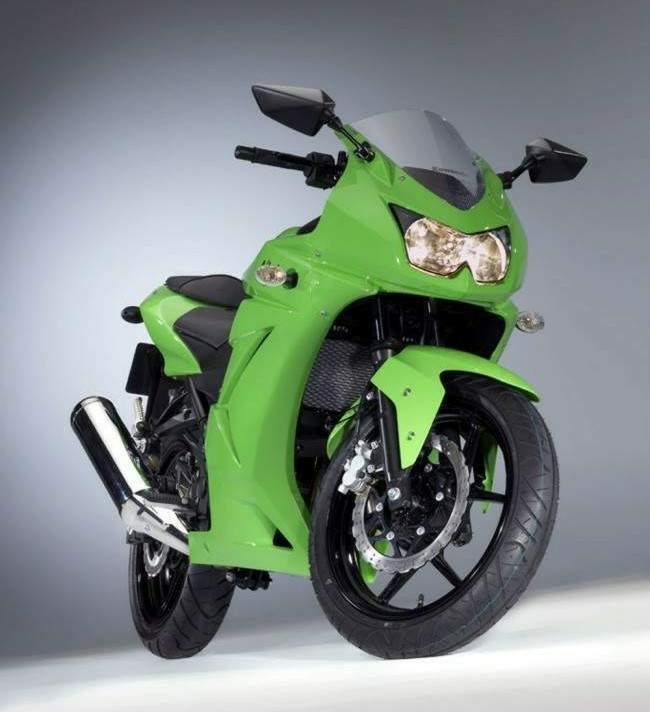
Kawasaki Ninja 250


The Kawasaki Ninja 250R (previous generations had market-specific names) is a motorcycle originally introduced by kawaski in 1983. As the marque's entry-levelsport bike The motorcycle has undergone few changes throughout its quarter-century lifetime, having received only two substantial redesigns.

Nomenclature

The fourth-generation model is marketed as the Ninja 250R in all markets. The motorcycle is also referred to by its platform designation, EX250, to which a generational suffix is attached. In the United States, previous generations of the bike (EX250-E/F/G/H) were already being marketed as members of the ninja family of sport bikes , while outside of the U.S. the bike was known variously as the ZZR-250, ZX-250, or as the GPX-250R. One of the earliest generations, the EX250-C, was given the name GPZ-250.

Description and features

The Ninja 250R's particular ergonomics, cahassis design, and engine placement have resulted in a motorcycle that straddles the standard andsport . The Ninja's riding posture also falls somewhere between standard and sport. The bike is capable of running the quarter mile in 15.58 s @ 81.98 mph (131.93 km/h), it had been 1 s faster in the prior generation, while providing the amenities of more utilitarian motorcycles, including bungee hooks for transporting cargo and space for a second passenger.

The latest model, the EX250-J or fourth generation, brought the Ninja's first major update in many years. Appearance upgrades included 17-inch wheels and completely redesigned fairings which give the motorcycle a sleeker, more modern appearance.

First generation

The first generation was produced between 1983 and 1984, and known by the production number EX250-C. It was sold as the GPZ-250. Sold only in its home market of Japan, this earliest, belt driven version was first produced in 1983, and shares no commonality with later generations. bike has 35mm fork tubes.

Second generation

Produced between 1986 and 1987 was the EX250-E. This model was sold as the Ninja 250R in Canada and the U.S. between 1986 and 1987. It was known as the GPZ-250R elsewhere. When originally introduced, it was more costly than the Honda Rebel, and reviewers complained that while the 14,000 rpm redline was nice, the engine was slow to rev

Third generation

For the 1988 model year, there were both cosmetic changes and changes in engine tuning. While the bore and stroke, and other major engine components, were unchanged, minor tuning adjustments were made. The carburetor diameters were reduced 2 mm to 32 mm (1.3 in), the cylinder compression ratio was increased from 12.0:1 to 12.4:1, and ignition timing advance was increased. Reviewers reported that this made the engine more free-revving, reaching the high 14,000 redline more quickly, and the tested top speed increased by a few miles per hour. The new, more fully-enclosed bodywork was complimented for being stylish, at the time, and easily mistaken for the larger ninja 750 .

The third generation of production of the Ninja 250 encompassed three models:

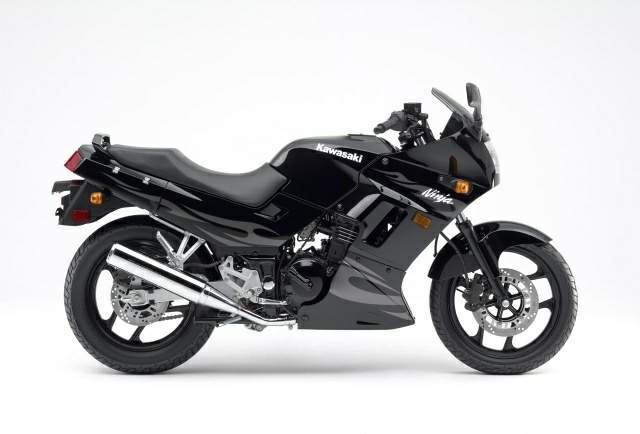
  • EX250-F - The most widespread EX250 variant, the E model was completely revamped and sold as the F model between 1988 and 2007 in the U.S. Canada received the model between 1988 and 1999, and it was available elsewhere as the GPX-250R as early as 1987.
EX-250-F Specifications
  • EX250-G - Sold only in its home market of Japan, this version was known as the GPX-250R-II. It featured dual front brakes and a wider wheel and tire (110/80-16). All other parts were identical to the -F model. It was sold after 1988.
  • EX250-H - This model came to Canada as the Ninja 250R between 2000 and 2002, after which it received a new name: ZZR-250, in line with the -H model's name elsewhere in the world, where it had existed since 1992. This motorcycle has few parts in common with the -F model, though it shares the same engine, albeit with different casings. It sports a lateral aluminum frame, a different fairing (designed to make it look sportier), larger 17-inch wheels, an adjustable rear shock absorber, adjustable brake and clutch levers, a smaller drive sprocket, computer-controlled timing advance, and a revised electrical system.

Fourth generation

In 2008, Kawasaki gave the EX250 its most thorough modernization in many years. The EX250-J model is known as the Ninja 250R worldwide, regardless of market.

Parts from the third generation are still found on the -J, but its redesigned exterior panels bring the Ninja's appearance out of the 1990s and into line with late-2000s sportbikes. The engine and drivetrain retain 30% of the -F model's parts, according to Kawasaki. The engine's compression and maximum torque have been lowered to provide better midrange performance. The redesign of the engine resulted in improvements in engine response at low engine speeds, and making the bike smoother and "much easier to ride." Though the previous generation Ninja 250 had a peak power of 1 horsepower (0.75 kW) more, or peak engine power of 5 horsepower (3.7 kW) more according to official Kawasaki specifications, according to testing by Motorcycle Consumer News, the new version's 20 or 30 percent increase in mid-range power allows the bike to pull from 3,000 rpm where previously it had to be revved to 4,000 rpm. The U.S. -J model uses dual carburetors the -F model, but the European, Brazilian and Thai models have fuel . The wheels were increased in size to 17 inches, the front suspension was improved, and the brake rotors were replaced with a larger petal shape. On the carbureted version, a fuel gauge was added in place of the temperature gauge. With the additional and redesigned equipment, the EX250-J suffered a 10 kg (22 lb) increase in wet weight over its predecessors.

With the arrival of the EX250-J, manufacturing continues to be located in Thailand

Kawasaki Ninja ZX-10R


Kawasaki Ninja ZX-10R

The Ninja ZX-10R is a Kawasaki Sport bike, and the follow-up to the ZX-9R . It was originally released in 2004 with minor revisions in 2005. It combines an ultra-narrow chassis, low weight, and radial brakes. In 2004 and 2005 the ZX-10R won Best Superbike from Cycle World magazine and the prestigious internationalMasterbike competition.

According to the Insurance Institute of Highway Safety, The ZX-10R has the highest theft and damage loss claim rate of any registered motorcycle.

Engine

Kawasaki engineers utilized a "stack" design for a liquid-cooled, 998 cc inline four-cylinder engine. The crank axis, input shaft and output shaft of the "Ninja" ZX-10R engine are positioned in a triangular layout to reduce engine length, while the high-speed generator is placed behind the cylinder bank to reduce engine width. With a bore and stroke of 76 × 55 mm (3.0 × 2.2 in), the ZX-10R engine's one-piece cylinder and crankcase assembly reduces weight and increases rigidity. The DOHC are machined from chromoly steel built for strength, four valves per cylinder improve high-rpm breathing, and the forged, lightweight pistons offer high heat resistance to further enhance the bike's power to weight ratio.

Cooling system

In addition to liquid cooling, the ZX-10R engine features an oil cooler adjacent to the oil filter to reduce oil temperatures. "Slosh" analysis was also used to design the internal structure of the oil pan, thereby reducing windage losses and helping to maintain low oil temperatures.

Clutch

A multi-plate wet clutch with a back Torque limiter transfers power to a six-speed, close-ratio transmission ideal for closed-course competition. The back-torque limiter automatically disengages the clutch under hard braking and deceleration to prevent rear wheel hop during corner entry. This also ensures complete control under hard braking.

Wheels

A new six spoke wheel design is claimed to be almost as light as special purpose race wheels. Since the 2006 model the sidewall profile of the rear tire has been increased from 190/50/ZR17 to 190/55/ZR17.

2006 model

Among other changes, the 2006 model featured twin underseat exhausts which contributed to a 5 kg (11 lb) increase in dry weight. The engine remained largely unchanged.

The 2006 ZX1000D6F model carried over to the 2007 model year, with only color scheme changes. The most noticeable difference between 2006 and 2007, is that the heat-shields on the exhaust pipes are black on the '07 ZX10R, and '06 came with silver ones.

2008 model

The ZX-10R was all new for its launch for the 2008 model year. There was a dramatic change in appearance with the bike featuring a much more angular front end. Kawasaki moved away from the twin-underseat exhausts of the '06-'07 model to a more conventional single side exhaust. The compression ratio of the engine was raised so that the engine now produces 188 PS (138 kW; 185 hp) @ 12,500 rpm and 200 PS (147 kW; 197 hp) @ 12,500 rpm with ram air.

2009 Model

Received only slight changes from the 2008 model.

2010 Model

Received slight changes from the 2009 model, including: upgraded Öhlins steering damper, upgraded transmission, and revised bodywork.

Specifications

All specifications are manufacturer claimed.

2004/2005 2006/2007 2008/2009/2010
Engine
Engine Type 998 cc (60.9 cu in) liquid-cooled inline four-cylinder
Bore/Stroke 76.0 × 55.0 mm (2.99 × 2.17 in)
Compression Ratio 12.7:1 12.9:1
Valve Train DOHC; four valves per cylinder
Fuel Delivery Fuel Injection
Ignition Computer-controlled digital transistorized
Drivetrain
Transmission close-ratio six-speed, slipper clutch
Final Drive sealed chain
Chassis/Suspension/Brakes
Front Suspension 43 mm inverted fork with top-out springs
Rear Suspension Bottom-Link Uni-Trak with gas-charged shock and top-out spring Uni-Trak with top-out spring, stepless, dual-range (high/low-speed) compression damping.
Front Brakes Dual radial-mounted four-piston calipers with semi-floating 300 mm (11.8 in) petal discs Dual radial-mounted four-piston calipers with semi-floating 310 mm (12.2 in) petal discs
Rear Brakes Single 220 mm (8.7 in) disc with single-piston caliper
Front Tire 120/70ZR-17
Rear Tire 190/50ZR-17 190/55ZR-17
Dimensions
Rake 24 degrees 25 degrees 25.5 degrees
Trail 102 mm (4.0 in) 106 mm (4.2 in) 109 mm (4.3 in)
Wheelbase 1,385 mm (54.5 in) 1,389 mm (54.7 in) 1,415 mm (55.7 in)
Seat Height 825 mm (32.5 in) 830 mm
Dry Weight
170 kg (375 lb) 175 kg (386 lb) 179 kg (395 lb)
Wet Weight


Fuel Capacity 17 L (3.7 imp gal; 4.5 US gal)
Performance
Max. Power Output 175 PS (129 kW) @ 11,700 rpm
184 PS (135 kW) @ 11,700 rpm with ram air
188 PS (138 kW) @ 12,500 rpm
200 PS (147 kW) @ 12,500 rpm with ram air
Max. Torque

83.2 lbf·ft (112.8 N·m) @ 8,700 rpm

Sunday, February 13, 2011

2011 Kawasaki Ninja ZX-10R

2011 Kawasaki Ninja ZX-10R
Description Road Manual 6sp 1000cc (Jan)
Engine(cc)998
Rider Capacity2
TypeRoad Bike
$18,999*
Price Guide
Full Specification

Engine
Engine Description 1000
Bore X Stroke 76 X 4
Compression Ratio 12.9:1
Valves per Cylinder
4
Cooling Liquid
Induction System Digital Electronic
Starter Electric
Lubrication Wet Sump
Transmission
Clutch Triple Plate
Primary Drive
1.611
Final Drive 2.412
Front Brake twin hydraulic ventilated discs
Front Brake Calliper Four Piston
Front Brake Diameter 310
Rear Brake Single-bore pin-slide petal disc
Rear Brake Calliper Single Piston
Rear Brake Diameter 220
Suspension/Frame
Frame Meterial
twin tube pressed aluminium
Front Suspension inverted fork
Front Suspension Travel 120
Rear Suspension
Uni-Trak with gas-charged shock
Rear Suspension Travel 125
Wheels and Tyres

Front Tyre
120/70ZR17M/C
Rear Tyre 190/55ZR17M/C
Wheel Type cast aluminium
Dry Weight 179
Fuel Tank Capacity 17
Length (mm)
2110
Width (mm) 710
Wheel Base (mm)
1415
Height (mm)1135
Rake25.5
Trail
110
PRICE
Available in Kawasaki’s Lime Green or Ebony, the new ZX-10R will retail for $13,799. The ABS version will cost $14,799. The new price represents an $800 increase over the 2010 base model. Other manufacturers are yet to reveal 2011 Superbike MSRP, but the new ZX-10R would make it the most expensive of the Japanese offerings and dead even with the 2010 MSRP for the base-model BMW S1000RR.

What does this new ZX-10R mean for Kawasaki? It’s no secret Team Green has been kicked around in the professional road racing ranks of late. A woeful ’10 campaign in World Superbike was just the latest in sub-par results for that series, and the Kawasaki has dropped off the competitive pace in Superbike racing worldwide. The previous Ninja redesign, which debuted in 2008, was supposed to right the ship. With the development cycles now spaced three years apart, the 2011 bike is charged with correcting Kawi’s fortunes on the racetrack. Whether that comes to be remains to be seen, but a little birdie tells us the ’11 bike circles Kawasaki’s Autopolis test track a full two seconds faster than its predecessor.

2011 Kawasaki Ninja ZX-10R Images
2011 Kawasaki Ninja ZX-10R

Thursday, January 6, 2011

Kawasaki Ninja 250R Bikes Price & Wallpapers

Kawasaki Ninja 250R Bikes
This is a type of European model launched by Bajaj. This is here to capture the Indian market at affordable prices. The aggressive and sporty looking 249cc bike equipped with liquid cooled, parallel twin, DOHC engine which generated the peak power of 32bhp t 11000rpm and the maximum torque of 22Nm at 8200rpm. It consists with 6 speed gear box transmission. The bike gives excellent braking performance and provides great comfort to its riders. The capacity of the fuel tank is 17 liters.
t is available in lime green and ebony black. The stunning bike is ready to give you a wonderful and unforgettable ride.

Have a look on road and ex-showroom price of Kawasaki Ninja 250 R across various cities in India:

Price of Kawasaki Ninja 250R in India:

Ahmadabad

On Road Price of Kawasaki Ninja 250R in Ahmadabad: We will update the prices soon
Ex-Showroom Price of Kawasaki Ninja 250R in Ahmadabad: We will update the prices soon

Bangalore

On Road Price of Kawasaki Ninja 250R in Bangalore: We will update the prices soon
Ex-Showroom Price of Kawasaki Ninja 250R in Bangalore: We will update the prices soon

Chennai

On Road Price of Kawasaki Ninja 250R in Chennai: We will update the prices soon
Ex-Showroom Price of Kawasaki Ninja 250R in Chennai: Rs. 2,69,580


Kawasaki Ninja 250R Bikes